Q&A with Kees de Gruiter
Underground Forest are reviving an ancient method of building on foundations of wooden piles driven into peat and clay. Burying tree trunks permanently stores the carbon they have accumulated over their lifespans, removing more carbon than any other form of forest management. By using wood instead of concrete for foundations, we can avoid emissions from cement and achieve net-negative construction — which is crucial when 40 percent of the EU’s emissions come from the construction industry alone.
De Gruiter says we have to fight the common misconception that it’s a “waste” to bury wood underground, and that it should be used instead. Actually, burying wood is the best way of storing that carbon and not returning it to the atmosphere — we should treat wood like coal and keep it in the ground, he says.
Underground Forest are in the process of getting CORCs (Carbon Offsetting and Reduction Credits) issued by Puro.earth, which can provide a source of income for farmers and land owners.
Q: What was your inspiration for Underground Forest?
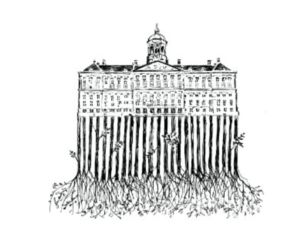
Venice. They weren’t thinking about CO2 when they built it, but they did store a megaton of CO2 in the wooden pile foundations that are still under the city. They made a universal foundation that has been used again and again for 1600 years.
Until 90 years ago, everything was built on wooden foundations in the north and west of the Netherlands: we have 25 million wooden piles in the ground, many of them centuries old, and they’re all in perfect condition. My own house was built on wooden piles!
All that carbon is still locked up. And there’s scientific proof that that carbon is contained for thousands of years, unlike trees that fall in a forest and release CO2 as they rot.
Q: Sounds logical. But should we be cutting down trees just to bury them?
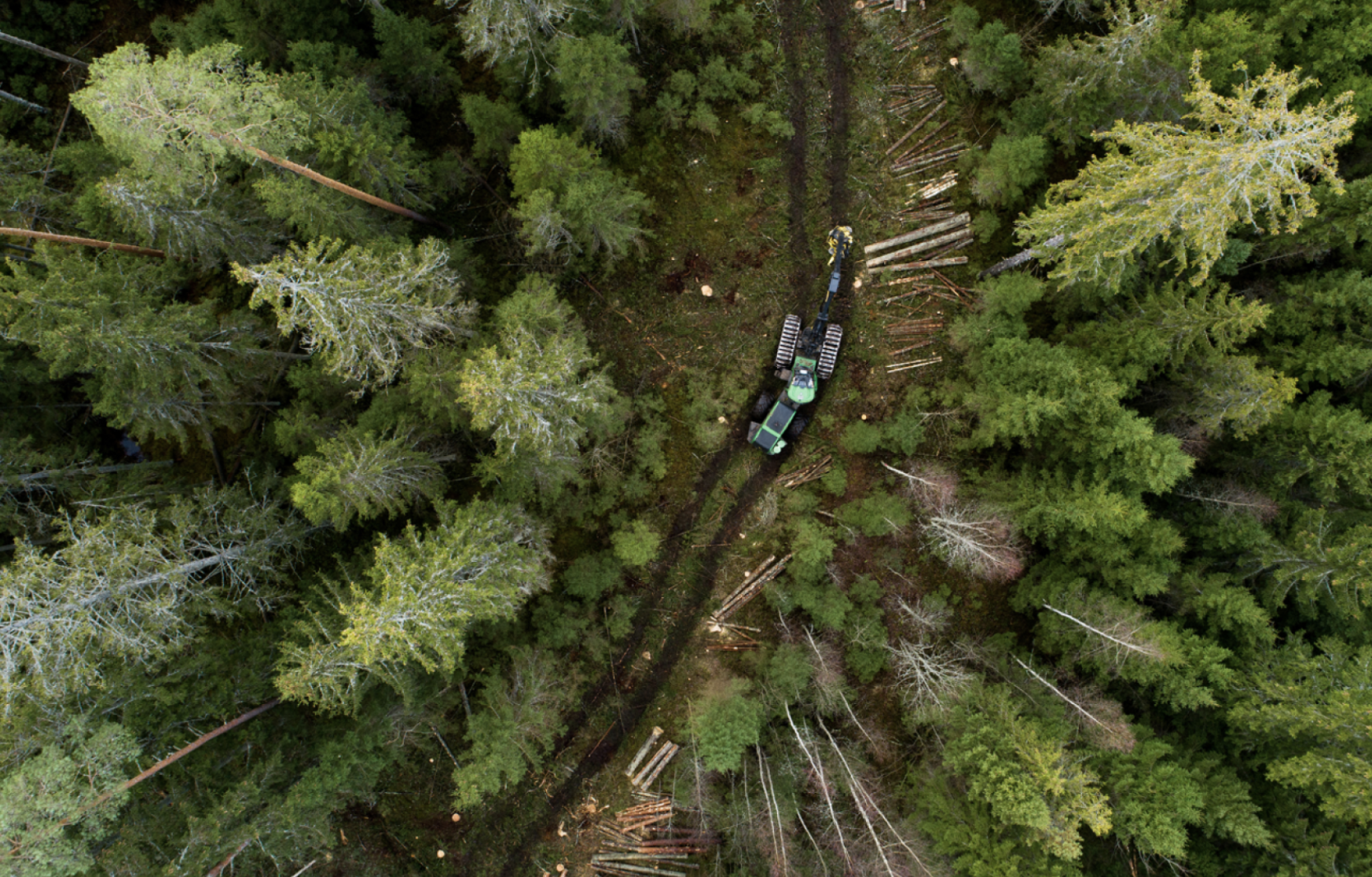
People don’t realise that all the CO2 a tree has sequestered during its lifetime returns to the atmosphere when that tree falls to the forest floor. A wild, unmanaged forest becomes mature in about 50 years and reaches a peak of around 500 tons of CO2 stored per hectare above ground. After that, about 2 percent of the stored carbon is released annually through natural decay and fire, so the forest transitions from being a carbon sink to being carbon neutral.
If you instead manage the forest and harvest 2 percent of it per year, then the amount of carbon sequestered by the trees is the same, and the carbon captured in the harvest can also be preserved instead of released back to the atmosphere. That means that managed forests remove twice as much carbon over 50 years compared to wild forests.
If you use harvested wood to make paper or pulp or burn it in a power plant, all the CO2 is released again within a year. If you use it for building materials, it may last 50-100 years. There is enough wood in the forests to harvest sustainably for wooden buildings on wooden foundations. So we should do both: keep our forests, and build with wood.
But the optimum way to really store that carbon permanently is to bury the wood in anoxic peat and clay. There is no method of forest management that removes more carbon than the Underground Forest method.
Q: Why has no one thought of this before?
Most people’s ideas of forests and wood are wrong. Just like coal, wood consists of biomass that has taken CO2 out of the atmosphere: they may have an age difference of 300 million years, but when it comes to burning it, it’s the same effect. Wood is not a “clean” source of energy.
It’s a sin to let a tree work for 50 to 100 years capturing CO2 and then burn it or otherwise release it to the atmosphere.
Q: What can you build on top of wooden pile foundations?
The piles are driven into the waterlogged soil vertically with their tops well below the groundwater level. We put a layer of low-emission concrete on top of the wooden piles, and you can build practically anything on top of that, as long as it’s not too heavy. Basically any building up to 70 meters tall.
But you also don’t have to build on top of it. You could, for example, plant a new forest on top of buried wood, potentially capturing 20x more carbon per hectare because the buried trunks can be packed much closer together than trees above ground.
Q: What are some of the co-benefits of this method?
We are in the process of getting certified with CORCs (Carbon Offsetting and Reduction Credits, issued by Puro.earth). Some of the income from the CORCs goes back to the builders and the owner of the land, which can be a huge incentive for them to use our methodology.
The global demand for voluntary carbon credits could increase 15-fold by 2030 and 100-fold by 2050. Demand outstrips supply by at least 1 gigaton, or $100 billion.
Q: What have you already achieved?
We’ve got a housing project of 42 units in the pipeline. The foundation would sequester 1400 tons of CO2, even taking the emissions of the concrete layer into account. Even if we factor in all the emissions from other parts of the construction, we think it will be the first carbon negative homes ever built in the Netherlands.
If that works, then the municipality may green-light plans for a whole new village built on wooden piles.
The company that invented a tap that can do cold, hot and boiling water, Quooker, used one of our construction partners to put some 6000 piles into the ground underneath the car park of their new production site. That dramatically decreased the ecological footprint of their building.
We’ve also signed a contract with a greenhouse builder, Kubo. They make all their foundations in wood and we get them certified.
Q: How much CO2 have you sequestered?
We have 10,000 tons in the pipeline over all these projects. We have 500 tons that are already certified and their carbon credits are ready for sale. And then another 1000 tons that are in the process of getting certified with Puro.
Q: What’s your end goal? What’s your vision of the ideal outcome?
We can reach a megaton in 2031. I think we’ll flatten out at 10 megaton a year eventually. There’s enough land with peat and clay to reach a gigaton a year with this method — you can do it in Bangladesh, the Mississippi Delta, Finland, the peatlands of Baltic states. The only limitation is how much wood you can source. Our methodology isn’t patented, so we could share it with others. We’ve been doing this for 2000 years and it’s up for grabs for everyone. But we hope to grow thanks to our headstart in getting the certification process started. There are very high demands for scientific proof and MRV (measurement, reporting, verification) in this field.
Q: What are the challenges and obstacles in your way?
The narrative of the forest is the biggest challenge. The technology is tried and tested, the business model is profitable. But the idea that it’s bad to “waste” a tree that could have been “useful” persists. We need to help people see that we actually save the tree and preserve its carbon forever.
Many people have some magical idea about what the forest does for us. Of course it’s extremely important for biodiversity, so we have to keep that forest floor. I would not harvest more than we can restore in a year. But the idea that it’s “wasteful” to put wood in the ground — that’s the narrative we have to change.
Another obstacle: construction companies are also quite conservative. But slowly the net negative idea is catching on. You can’t build net negative on a concrete foundation.
Q: What do you wish people outside the climate space knew, that those inside the climate space already know?
This is something people inside the climate space also don’t know: the forest is not taking CO2 out of the atmosphere. The tree is, but the forest as a whole isn’t! That’s a hard thing to grasp. You can only have so many trees on a single hectare. All those leaves are competing for a place in the sun. If a tree falls down, it rots and starts releasing CO2 again. There’s hardly any carbon in the soil of the forest, it doesn’t sequester it like a peatland or a marsh.