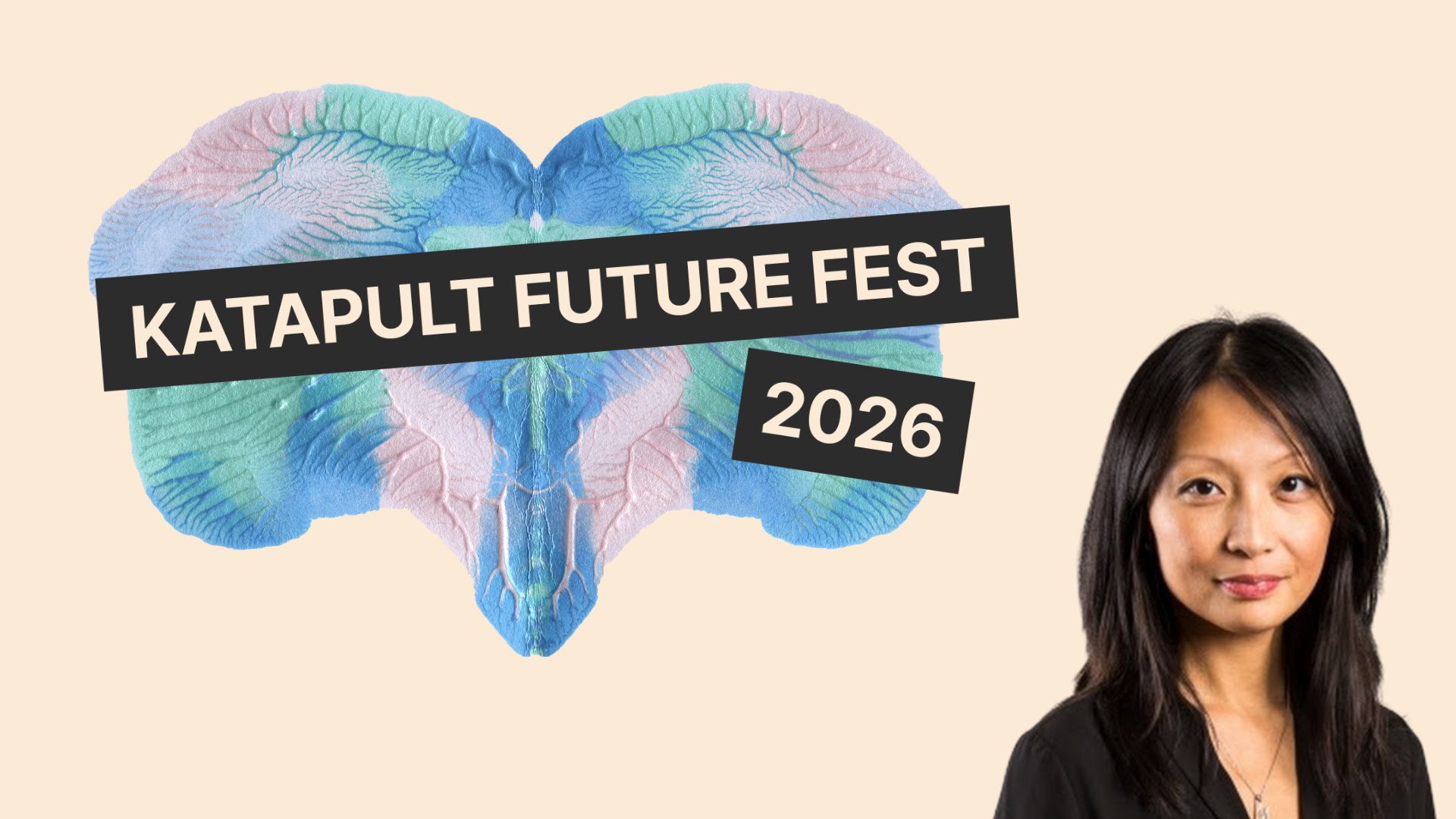
Founders Q&A with Evita Zanuso, co-managing director of Katapult Future Fest
Katapult Future Fest, a transformative gathering of changemakers, is coming to Amsterdam in May 2026 – and we’re supporting them! Evita Zanuso, co-managing director, tells us about what makes KFF unique and what we can expect from this edition.
What is Katapult Future Fest?
At its heart, KFF is about genuine, authentic connection. We discuss big challenges and solutions, and we bring together investors, entrepreneurs, and change-makers — but we believe that without real connection, nothing actually happens. It’s not transactional, unlike most events.
Our community dinners in Amsterdam are a good example. They’re a way for people who can’t afford a ticket to still participate — guests can host eight people, including themselves. Some of the most remarkable stories have come out of those dinners. One of the biggest investors in the Netherlands met someone at one of those dinners, connected them to another investor, and they started a business together. Those serendipitous moments are what make KFF magical. Impactful projects only happen through genuine human connection.
How did it come into being? What are its origins, the seed of inspiration?
Tharald Nustad founded KFF, drawing inspiration from two very different gatherings: Singularity University, with its focus on exponential technology and collaboration, and Burning Man, built around participation and radical creativity. He wanted to create something joyful and fun, but purposeful.
This year, we’ll have two days at Ruigoord in Amsterdam — a remarkable creative community that grew out of the squatting movement and has resisted many attempts to close it down. A green oasis just outside the city, surrounded by harbor and industry, it’s home to artists and creatives who represent a very different kind of culture. They have deep links to indigenous communities, and working with them is a genuine partnership, not a venue hire.
Tharald describes the festival’s animating idea as “Entering the Metamorphosis”: the belief that the extractive economy is ending, and something regenerative wants to emerge. KFF aims to create the conditions for that emergence.
What are you most excited about for this edition?
Moving from Oslo to Amsterdam is a big shift, and we’re excited about the new partnerships it’s brought — with CarbonFix, with DOEN, and with the City of Amsterdam. The world is in a turbulent place right now, and we’re not pretending otherwise. Impact entrepreneurs are facing real difficulties. But we want people to feel they have agency in what’s unfolding — not just passive observers, but active participants in shaping what comes next. Hope matters. So does meeting others who feel the same way, and being reminded that genuinely positive things are happening, even amid the daily noise.
What have you achieved so far? Are there any developments you’ve witnessed sprouting out of previous festivals?
The most tangible examples are a couple of projects. One is a group called TWIST: Investors for Systems Transformation. It began as a conversation inside KFF among impact investors asking whether individual-level impact was enough, or whether they needed to think at a systems level. The KFF foundation incubated it, and it’s now a fully-fledged community of practice with hundreds of members. MIT has used their case studies in academic papers — a real, living example of what can emerge from the right room with the right people.
A second initiative, the Coalition for Impact, brings together organizations including The Impact, Tonic, the BMW Foundation, and CSP — a training provider focused on impact investing and systems change. Together, they’ve mapped financial systems change from a wealth perspective, identifying specific leverage points for shifting the financial system.
Beyond these, I know of businesses started, and people who’ve left jobs to found their own impact organizations, because of KFF. The ripple effects are hard to fully measure.
What makes Katapult different from other festivals or gatherings?
It’s how we make it non-transactional, and how we design for genuine participation.
One format we use is called Seat at the Table: experts begin discussing a challenge, then step aside and invite audience members to take their place and speak as equals. On Friday, a large portion of the program is given over to an Unconference — space for people doing extraordinary things who don’t have a big name or platform. Stars like John Fullerton and Kate Raworth will be there, but brilliance doesn’t always come with a public profile.
Consciousness underpins all of our themes: it’s the soil that makes everything else possible. Unless we’re aware of how we’re showing up and working with others, nothing else really holds.
And we make space for joy. A clothes station using repurposed garments, a glitter station, and deliberately fun elements pull people out of their professional identities. Jed Emerson, often called the father of impact investing, has been known to walk around in pink trousers. The work is serious — but we want to do it in a way that’s genuinely enjoyable, because we think that matters too.
What will CarbonFix’s money enable you to do that you wouldn’t otherwise be able to?
Financial foundation and integrity: It protects our financial integrity. We say no to sponsorship that would compromise our program — we don’t do pay-to-play. Most conferences rely on corporate sponsors who expect speaking slots in return; we don’t, and the CarbonFix grant is a meaningful part of what makes that possible.
Subsidizing change-makers: It subsidizes attendance for change-makers who couldn’t otherwise afford to come — early-stage founders and NGOs for whom the ticket price is simply out of reach.
Supporting global participants: It supports participants traveling from the Global South or other distant locations who want to be part of this but can’t cover transport and accommodation.
Post-festival infrastructure: Perhaps most importantly, it funds what comes after the event. We don’t want the energy to dissipate once people go home. Specific launches — around ocean conservation, AI safety, and alternative narratives — will follow. Working groups will form, and we’ll support them if momentum builds, much like TWIST and Coalition for Impact at previous KFFs. What we’re trying to build isn’t just a festival; it’s a movement.
What’s your vision of the ideal outcome of this year’s festival? What do you hope to see?
Our hope is that people form genuine collaborations. Many attendees already think at a systems level — but many don’t. We’d love for the curious ones to discover it here. New ideas should emerge from the collision of different perspectives.
Above all, we want to create a kind of emergence. What happens when an AI researcher, a farmer, and an artist end up in the same room and grow curious about each other’s work?
Expanding people’s imagination is central to what we do. So many talented people feel trapped because they can’t see the results of what they’re working on. We want them to leave with a clearer sense of the big picture — and their place in it.
What kind of social and cultural will is needed to bring the seeds you plant to fruition?
Culturally, we need structures that allow for experimentation and failure. A new system won’t emerge fully formed. Funders and investors need to support learning and emergence, not just execution — to celebrate iteration and progress, not only success stories. That’s a genuine mindset shift, and not an easy one.
Economically, we need metrics aligned with human and planetary wellbeing, catalytic capital with long time horizons, and ownership models that tie incentives to regeneration rather than extraction. These frameworks already exist — Dutch entrepreneurs I speak with regularly know them and are eager to put them to work.
Going to such a festival can make you feel like you’re among like-minded people. What do you wish people outside of that “bubble” knew — and is there a way to spread that message?
The transformation is happening whether we engage with it or not — the old system is dissolving, with climate disruption, democratic backsliding, and deepening instability. The question isn’t whether change is coming; it’s whether we actively shape it or simply react in crisis mode.
What looks like idealism from the outside is often just pragmatism. Regenerative agriculture isn’t a niche philosophy — it’s the only farming model that remains viable when soil degrades and weather becomes unpredictable. Catalytic capital isn’t charity; it’s the investment structure best suited to unlocking solutions at scale and speed. If you’re even a little curious, it’s worth showing up.
We meet people where they are. Not everyone will come, and that’s fine. Those who do, though, will carry these ideas back into their own communities and spheres of influence — because the transformation we’re working toward needs to spread far beyond the festival itself.