Since the advent of modern air conditioning in 1902, vapor compression has remained the dominant cooling technology. Today, 95% of all cooling equipment relies on it.
As the world gets hotter, demand for cooling is only rising. But air conditioning is hugely energy intensive, using around 20% of all electricity use in buildings. The majority of A/C adoption is going to come from fossil fuel grids.
What’s more, the hydrofluorocarbons used as refrigerants in vapor compression systems are super-polluting greenhouse gases, with a global warming potential thousands of times worse than CO2. Their leakage is projected to contribute to over 11% of all greenhouse gas emissions by 2050.
There’s been various innovations in cooling tech, but none efficient, cheap and effective enough to win over the market. Most cooling simply moves the heat from one place to another, which worsens urban heat islands and doesn’t help a warming planet.
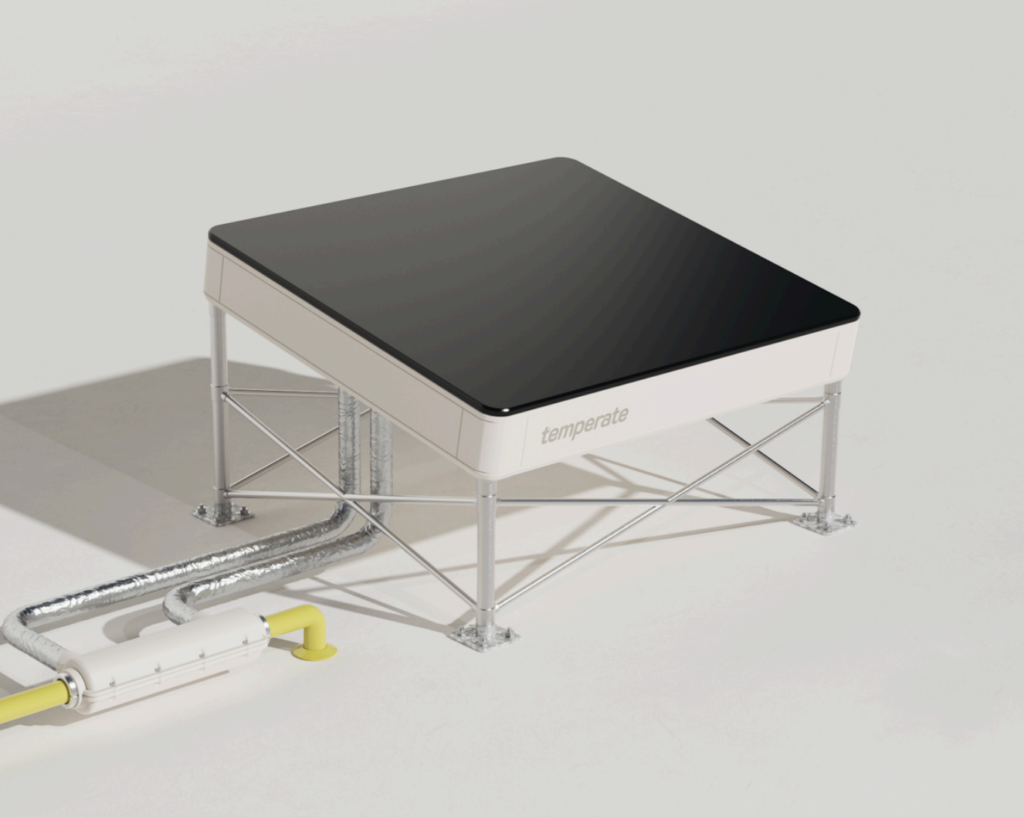
Unless… we could move the heat into space? That’s the idea behind radiative cooling, a basic principle of physics that, with a little bit of tweaking, can be manipulated into creating passive cooling units with extremely low electricity consumption and no negative consequences. Sound too good to be true? Well, it’s early days, but Temperate might just be on the edge of a cooling revolution.
1. Can you explain your project to me in simple terms?
Our solution draws on a very recent innovation that radiates heat out to space in the form of infrared. The innovation works on a basic principle of physics: that heat is emitted as light. You know when someone puts a sword in hot coals in a movie? The sword lights up and gets brighter because the heat is being emitted as light. It’s the same principle at play when you feel the temperature drop on a cloudless night, as the heat on the surface of the earth bounces back into space as infrared radiation. We can’t see it with our human eyes, but Earth is glowing with infrared radiation in exactly the same way as a sword glows.
We’re just manipulating that principle. We take this core principle of physics and we tweak it such that we are able to turn everyday ambient heat in the world into infrared radiation in this specific spectrum and exhaust it into space.
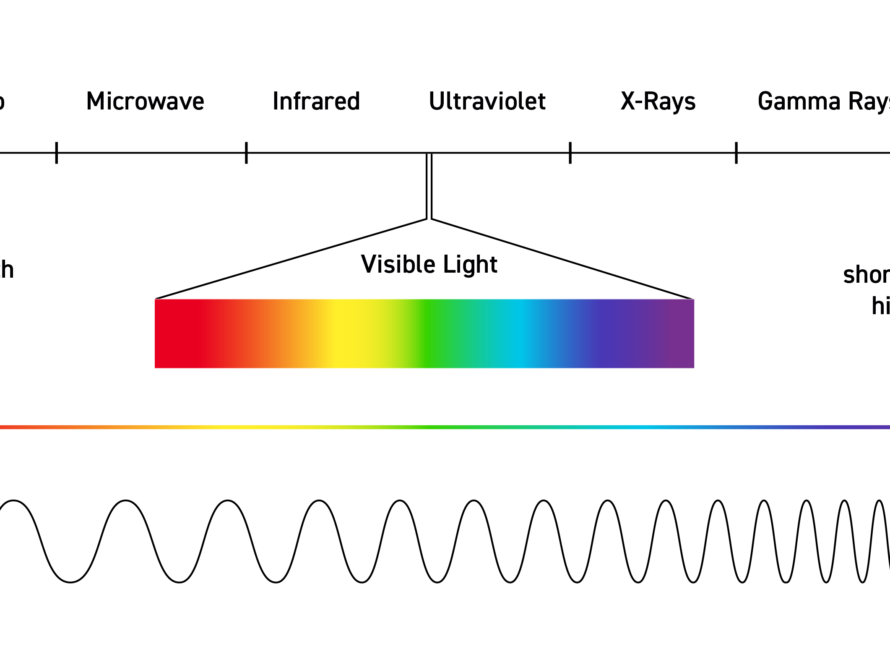
Along the electromagnetic spectrum, there’s different wavelengths (see diagram below). We turn heat into a specific wavelength range of infrared radiation – 8 to 13 micrometers – that aligns with what’s called the atmospheric window. Think of it as a super highway to space. Radiation in this range passes straight through the atmosphere rather than being absorbed and bounced back, allowing heat to escape into the cold of outer space.
We aim to make an indoor cooling unit that runs on as little electricity as your wireless router, and think we’ll be able cool a space down to about 22°C (71.6F).
2: What’s your vision?
That we cool the planet by a degree. We’re able to pioneer a technology that makes cooling extraordinarily cheap, for residencies, that we can plug into a sea current and cool the ocean. We could cool whole cities.
3: Tell me, why exactly does cooling matter so much?
Cooling is the biggest problem facing humanity. It’s the largest environmental problem. More people die of heat than tsunamis and wildfires. More people die in Europe because of heat than Americans die of gun violence. If it’s 100% humidity and above 35 degrees, people die en masse. We’re going to see that much more in the next 10 years unless we start building city-wide cooling systems.
The sunlight is not the issue. The refrigerant gases are not the issue. The real issue is the heat. The thing that’s causing humanity (and the planet) issues is the heat. Everything else is second-order effects from the heat. Carbon might be causing the issue, but heat is what’s causing us the pain.
Cooling has become a privilege because of the cost of A/C. But it shouldn’t be: it should be at the very bottom of Maslow’s hierarchy of needs. Cooling has been central to human evolution. Standing up and moving around on two feet and our ability to sweat allowed us to run long distances and outrun both prey and predators.
4. There’s been very little innovation in cooling for a long time. Who was the first to think of bouncing heat back into space on the infrared spectrum?
It’s recent: researchers published a paper in 2014 in Nature on ‘Passive Daytime Radiative Cooling’, or PRDC. Now there are maybe 10 companies doing PDRC, of which SkyCool is probably the most well-known. These companies make films, layers or paints that bounce heat back into space as infrared.
We are different because we have managed to squeeze more cooling capacity into the same area by cleverly manipulating the light. We’ve achieved significantly more cooling per sqm.
Plus, all these solutions need to be sky facing – meaning they’re limited by the available surface area. We’ve found a way to do things differently. The cool thing about light is that you can bend it, which means we can make a high volume of cooling in a much smaller space.
We’re doing that with our first units, where we’re building a system that improves the efficiency of existing cooling systems with a simple plug-in. Our second product will be a wall-mounted AC that operates at a fraction of the cost of a traditional AC unit.