

Growing Oceans
CarbonFix cohort
Type
Founders
Type of intervention
About this project
Growing Oceans is a non-profit team of ocean scientists from universities across the Pacific learning from existing natural processes that take carbon dioxide out of the atmosphere and store it deep in the ocean at massive scale.
A collaboration between Growing Oceans and the Kingdom of Tonga in the South Pacific is focused on the role of nitrogen fixation in supporting phytoplankton populations, which are the base of ocean food webs and support ocean biodiversity and life. Phytoplankton pull CO2 out of the atmosphere when they photosynthesize and store that carbon long-term when they die and sink to the ocean depths.
This collaboration is working to understand how naturally-occurring additions of iron coming from volcanic hydrothermal vents in Tongan waters are helping beneficial plankton to grow, which in turn supports higher-than-usual sequestration of carbon dioxide out of the atmosphere every year.
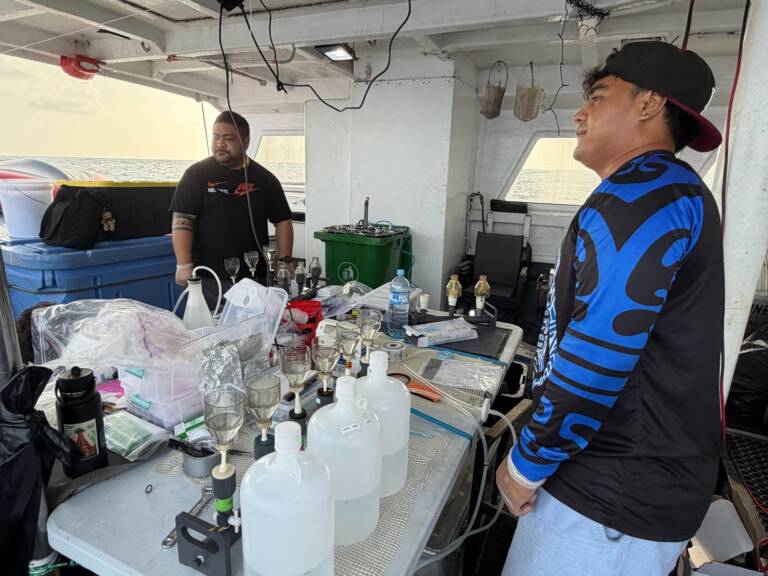
In early 2026 the team is conducting ocean surveys and laboratory analyses with Tonga experts to measure the impact of this volcanic iron on the ecosystem. They are working closely with these Tongan scientists to build the knowledge base and capacity for Tongan decision makers to consider next steps.
By studying nitrogen fixation in nature, Growing Oceans aims to lay the groundwork for approaches that sustain biodiversity while increasing the ocean’s ability to store carbon safely at scale.
Founder Q & A
Q: What’s your end vision here? What’s your ideal outcome?
Seth John: We want to fully understand the promise of this approach as a climate solution, while remaining very aware of any potential risks. In theory, every atom of iron added to the surface ocean can pull 23,000 carbon dioxide molecules in the ocean, meaning that there is a tremendous potential for carbon storage and ecosystem benefits. Studying the naturally-occurring process will give us a lot more information about how this process actually plays out in the oceans. The ideal outcome is to develop a clear set of scientific findings, which Tonga and other South Pacific island nations can use to make decisions about how to move forward.
Q. What are you hoping to understand with this expedition in Jan 2026?
SJ: We want to understand the natural response to the iron released by the hydrothermal vents. So we’ll be measuring ecological response, the nitrogen fixers, and even looking at fisheries and birds to see if their populations higher up the food chain are affected. Ecological safety is a focus, so we’ll be checking if there are any harmful algal species growing that could be feeding off the extra nitrogen. The natural input of iron from these hydrothermal vents is happening on a scale of hundreds of square kilometers, so it’s a big task to map and understand the impacts.
This has also been one of our first opportunities to work directly with Tongan scientists from the Ministry of Fisheries and the Ministry of Lands and Natural resources. They’ve been helping us to set up experiments and analyze samples, and they’ve been an extraordinary resource helping us to understand the local ocean environment and ecology.
Read the full interview with Seth John here.